On provisional truths, graphite, and the small magic of being allowed to be wrong – by Mark Kagi
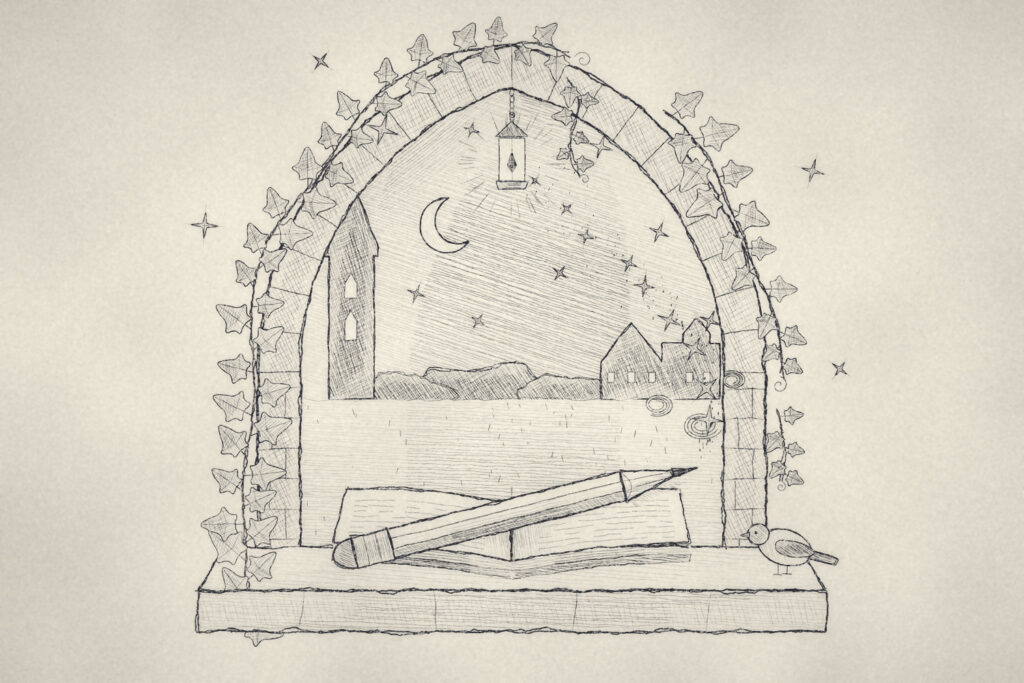
There is an hour, somewhere between the last of the afternoon and the first of the lamps, when the old quadrangles of the world seem to hold their breath. The ivy stops rustling. The stone remembers it was once a mountain. And if one is very still, and has had precisely the right amount of tea, it becomes possible to feel that the whole evening is about to be annotated by someone.
I mean this nearly literally. I have long suspected that the universe is a text of enormous length and uncertain authorship, and that our task, as its readers, is to write in the margins. The only question worth a serious seminar is: in what?
Ink Is for Conclusions
Ink, I submit, is the medium of the finished. It belongs to treaties, to signed confessions, to tattoos acquired in moments of conviction. Ink says: I have decided, and the matter is closed.
The old Latin tag reminds us that verba volant, scripta manent: spoken words fly away, written words remain. A fine proverb, but it neglects a third and rather more charming category: the pencilled word, which manet, donec deleatur. It remains until it is erased. (The Latin is my own, and I accept all liability.)
To write in pencil is to say something wonderfully modest: this is my best understanding at present, and I reserve the right to be astonished. It is the grammar of the working mathematician, of the cartographer sketching a coastline she has only glimpsed, and of every student who has ever written “?!” beside a line of Kant and meant it sincerely.
Socrates, naturally, outdid us all by writing nothing whatsoever. He is the lightest touch in the history of philosophy, a man who left no marks except the faint impressions in the people he questioned. Keats, who knew a thing or two about lightness, gave the temperament a name: negative capability, the capacity of being “in uncertainties, mysteries, doubts, without any irritable reaching after fact and reason.” I can think of no better description of a well-sharpened HB.
It is also a mildly delicious fact that Henry David Thoreau, who went to the woods to live deliberately, spent a good portion of his youth in his family’s pencil trade, and was said to be rather good at it. One imagines the pencils were the sort that make a person want to write something worth erasing.
A Brief Note on Dust
Sharpen a pencil over a clean sheet of paper, in good late light, and tell me the shavings do not glitter. The graphite dust is, I am assured by those who study such things, merely carbon. I am assured by those who study other things that carbon was forged in the hearts of stars, and that we have all been lightly dusted with it since the beginning.
I make no further claims. I note only that my better ideas have a habit of arriving directly after sharpening, and that the sparrow outside the library window has begun to regard me with something like professional interest.
The Eraser, Considered
The eraser is the most underrated instrument in the history of thought. It is intellectual humility in a small pink wedge; it is to the pencil what “on the other hand” is to the lecture.
And yet an erasure is never total. Hold the page to the light and the old line is still there, a pale ghost beneath the new one. Scholars have a lovely word for a page that has been written over and written over again: a palimpsest. I have come to think that wisdom looks exactly like this. Not a clean page, but a well-loved one, scuffed with former certainties, each of them still faintly audible if you tilt it toward the lamp.
I like to believe there is a small, tidy attic somewhere where all the erased lines go, and that they are quite content there, rearranging themselves into something quieter and better.
Sharpened, Then
This, then, is the premise of the little blog you are reading. You will have noticed that the welcome promised musings and not pronouncements. Everything here is written in pencil. Disagree freely; the eraser is at your disposal, and the lamps have just come on. Veritas, as certain old gates have it, but sharpened to a fine point.
Until next time: keep something sharp, and something erasable.
What would you write in pencil tonight? Leave your best provisional thought in the comments.
Leave a Reply